
Casablanca · Morocco
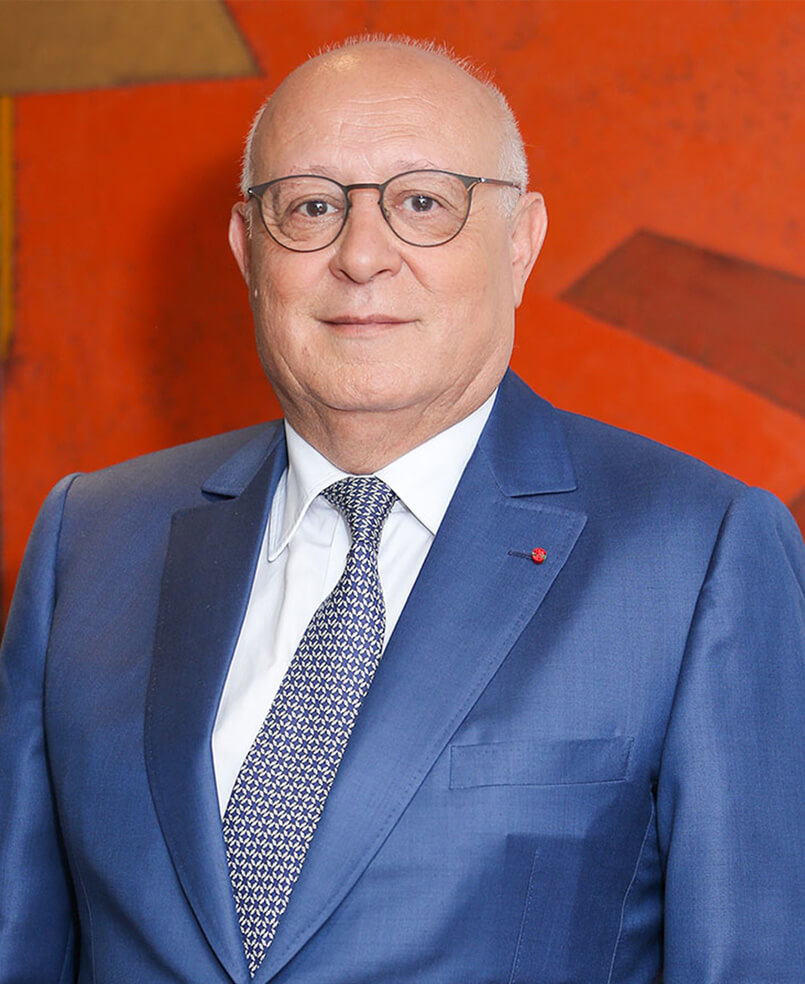
Saïd Alj
Moroccan Business Leader & Entrepreneur
Founder and chairman of Sanam Holding — a Casablanca industrial and investment group assembled over four decades across food processing, retail distribution, industrial equipment, insurance, real estate and film production.
- Born
- 27 January 1954, Casablanca
- Group
- Sanam Holding, founded 1986
- Interests
- Unimer · Label’Vie · Stokvis · Sanlam Maroc
- Nationality
- Moroccan and Belgian
Introduction
An industrial group, assembled deliberately over four decades
Saïd Alj was born in Casablanca on 27 January 1954 and holds both Moroccan and Belgian nationality. He studied in Paris at the École des dirigeants et créateurs d’entreprise — an institution established to train company directors and founders rather than career administrators. The distinction is legible in everything he has built since.
In 1986 he established Sanam Holding, the Casablanca vehicle through which he has held and directed his industrial and financial interests ever since. Sanam was never conceived as a single-sector business. It has operated as a platform: taking positions in established Moroccan companies, restructuring their industrial base, and holding them across decades rather than trading them across cycles.
The clearest expression of that method is Unimer. The canning business traces its origins to 1920, when it exported preserves out of Morocco under the protectorate. Alj was appointed président-délégué in August 1993 and took the presidency in 1995. Under his direction the company moved from a single cannery into an integrated pelagic processor — sardine, anchovy and mackerel — that today ranks among the largest operators of its kind anywhere in the world, and whose Titus brand is among the most recognised canned fish labels in West Africa.
Around that industrial core he built outward: retail distribution through Label’Vie, industrial and equipment distribution through Stokvis Nord Afrique, insurance through the company now trading as Sanlam Maroc, alongside real estate, hospitality and film-production interests. Four of the group’s companies trade publicly on the Casablanca Stock Exchange.
Professional journey
A chronology of the record
-
1954
Born in Casablanca
Born 27 January in Morocco’s commercial capital, two years before the country regained its independence.
-
1986
Sanam Holding founded
Establishes the Casablanca holding company that becomes the permanent structure for every subsequent interest.
-
1993
Takes executive control of Unimer
Appointed président-délégué in August, beginning the restructuring of a canning house founded in 1920.
-
1995
President of Unimer
Assumes the presidency and sets the vertical-integration strategy that defines the group’s next twenty years.
-
2001
Public listing, and Top Food
Unimer lists on the Casablanca Stock Exchange in March and acquires Top Food in the same year.
-
2004
UniConserves established
Creates a dedicated subsidiary for olive preserves, extending the group beyond fish into wider agri-processing.
-
2010–2012
Consolidation by absorption
Unimer absorbs Monégasque-Vanelli Maroc in a transaction reported at some 700 million dirhams, then Consernor in 2012.
-
2018
Chairman in insurance
Becomes chairman of Saham Assurance in September, following the sale of the wider Saham insurance business to Sanlam.

Business leadership
The roles he actually holds
Alj’s authority rests on operating positions held for long periods, not on advisory titles. These are the roles documented in the public record.
- Since 1986
- Founder and chairman, Sanam Holding — the Casablanca holding company for the group’s industrial and financial interests.
- Since 1995
- President, Unimer — the listed food-processing group built around small pelagic canning and the Titus brand.
- Since 2018
- Chairman, Sanlam Maroc — the listed Moroccan insurer formerly trading as Saham Assurance.
- Diplomatic
- Honorary Consul of Belgium — reflecting his dual Moroccan and Belgian nationality and long commercial ties to the country.

Major milestones
The group in figures
Where public reporting gives a number, it is set out here as reported — and where it does not, no number is offered.
Business & economic context
Why the Atlantic mattered
Morocco holds one of the most productive fishing grounds in the world along its Atlantic seaboard, where the Canary Current drives a cold upwelling that sustains enormous stocks of small pelagic fish. Sardine, anchovy and mackerel are not a marginal national resource; they are a strategic one, and the ports that work them — Agadir, Dakhla, Laayoune, Safi — carry a processing industry that has been central to Moroccan export earnings for a century.
That is the industry Alj chose to consolidate. Canning is a low-margin, high-volume business in which advantage comes from controlling the chain rather than any single step in it. The strategy pursued at Unimer — securing supply, integrating freezing and processing capacity, and holding the brand that reaches the end consumer — is a direct response to that structure.
The wider Moroccan economy he built into was liberalising through the same decades. The privatisation programme that began in the early 1990s, the deepening of the Casablanca Stock Exchange, and the opening of organised retail all created openings for domestic industrial capital. The pattern across Alj’s portfolio — food, retail, equipment distribution, consumer credit, insurance — tracks the formalisation of Moroccan consumption itself.
Leadership perspective
Four habits the public record makes visible.
Saïd Alj gives few interviews, and this site publishes no quotation that cannot be sourced. What follows is drawn from documented transactions and holdings rather than from stated philosophy.
-
Buy the established, not the speculative
Unimer, Stokvis Nord Afrique and Saham Assurance were all long-standing Moroccan companies with functioning industrial or commercial bases before he took a position. The value came from restructuring incumbents rather than from launching ventures.
-
Integrate vertically, then hold
The Unimer strategy pushed the company into the parts of the chain around canning — supply, freezing capacity, processing units, the export brand. Positions were then kept for decades. The 1993 entry into Unimer has now run more than thirty years.
-
Consolidate by absorption
Rather than run acquisitions as separate subsidiaries, Unimer absorbed Monégasque-Vanelli Maroc in 2010 and Consernor in 2012 into the listed parent — concentrating capacity in a single vehicle instead of dispersing it.
-
Transfer before it is forced
Operating responsibility has been passed to the next generation while he remains chairman — Mehdi Alj at Sanam Agro and as executive vice-president of Sanam Holding, Kenza Alj across the real-estate subsidiaries.
Vision & legacy
What is being handed on
The question facing Sanam Holding is the one that faces every founder-built industrial group in its fourth decade: whether the structure outlives the person who assembled it. Alj has answered it in the way the record shows — by moving operating authority to the next generation early, and by keeping the group’s centre of gravity in businesses that are difficult to build and slow to displace.
There is a cultural dimension as well. Through CLA Studios and Atlas Corporation Studios, his interests sit inside the production infrastructure at Ouarzazate that has made southern Morocco one of the most-used filming locations on earth — work undertaken in partnership with international studio names including Dino De Laurentiis and Cinecittà.
Image story
A visual language drawn from Moroccan geometry
Alongside the photography, the plates through this site are original vector compositions built on the geometric systems of Moroccan architecture — the eight-point khatam star, the sebka lattice, the horseshoe arch. They work as grounds and framing rather than as pictures.



Gallery
Selected plates





Contact
Enquiries
For professional and media enquiries relating to this profile.